
Have you ever tamed a pet?
Well, if you haven’t, you must! Be it a dog, rabbit, cat, or a small fish, pets are lifetime companions till you die! Even if they don’t know how to speak, they’ll still understand and be with you! Petting a fish gives you a similar feeling and when it is Six Line Wrasse, it would be the best thing to see once you get back home after a long tiring day! No matter how you are feeling, your pet will always love you!
Deliberating the same, today we are going to discuss a few things about one of the most beautiful creations of God in the fish species, i.e. Six Line Wrasse which has many unique characteristics making it very special from other fish breeds. So, are you guys, ready to find out some amazing attributes of this pretty and alluring fish?
All set to explore?
Here we go!
About Six Line Wrasse
Below mentioned are some of the basic details related Six Line Wrasse, let’s begin:
Emergence and Spread
Six Line Wrasse are basically found in the reefs of Indo-Pacific and the coastal areas of Fiji. They can be found mostly in areas where the water is warm, shallow, and clean. This is one of the most active fishes in the world. Apart from the marine space, these fish can be kept in aquariums with some rocks and sand to hide and also to find food for their survival. Basically, they belong to the Labridae family from the species of aquatic ray-finned fish. They can also be seen on the east coast of Africa, South Africa, the red sea, the Indian Ocean, the West Pacific Ocean, the North part of Japan, South to North Australia, and the Tuamotu Islands.
Structure and Gender
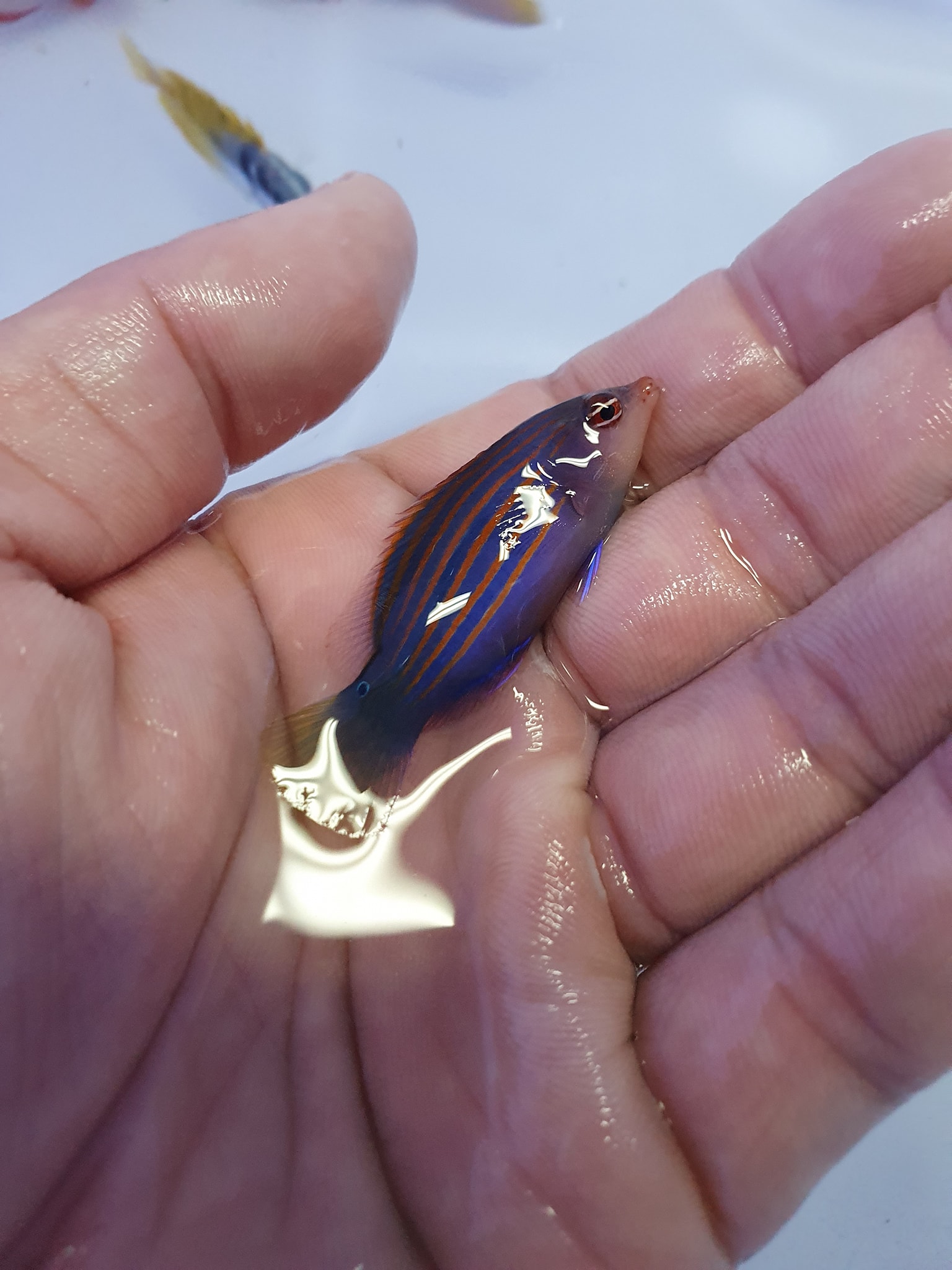
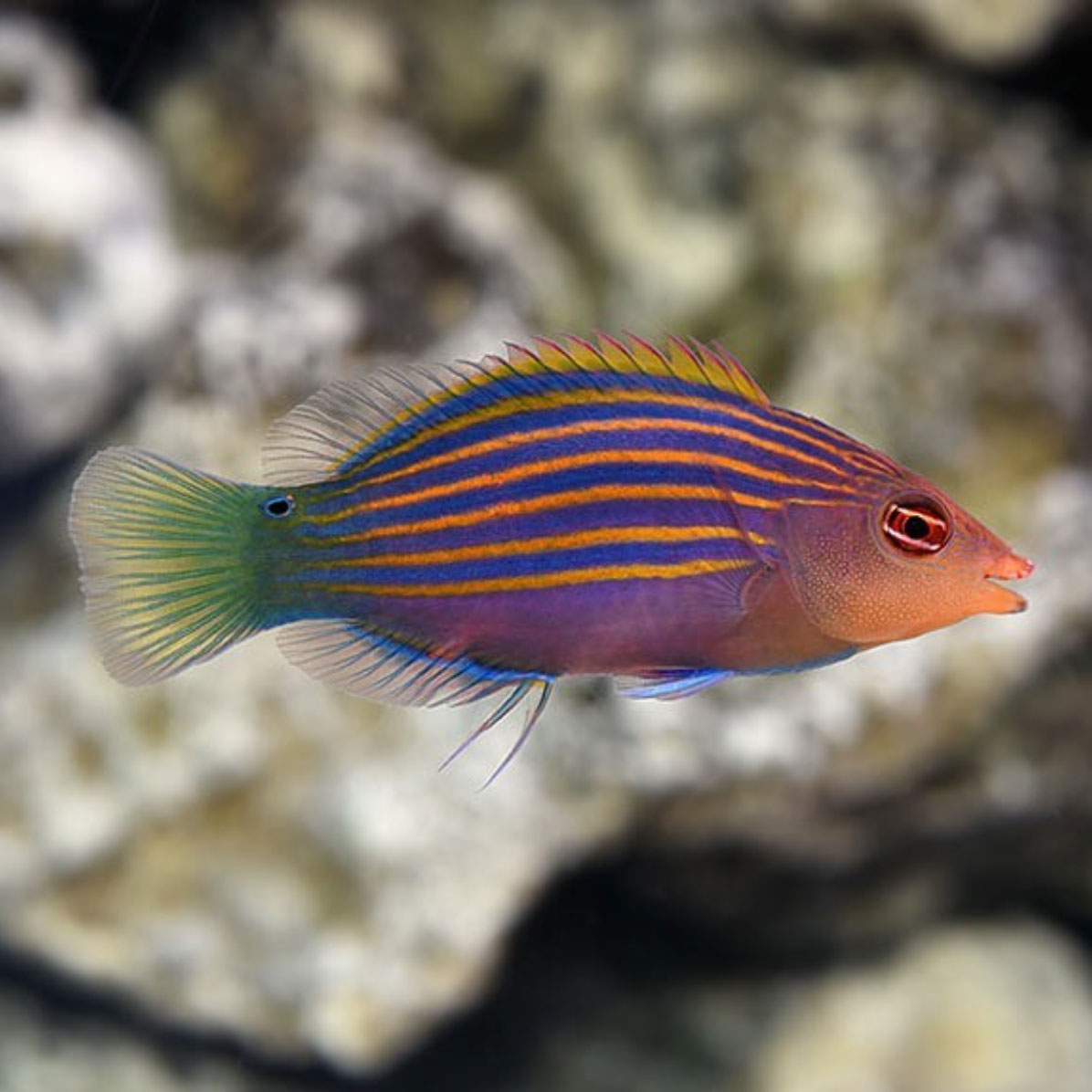
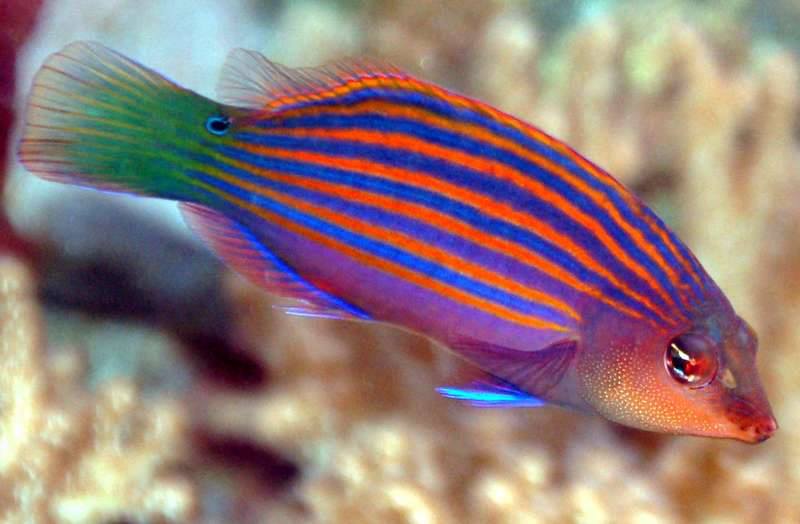
The structure of six line wrasse is remarkable. Out of six different varieties; these fishes have horizontal orange and red lines on the bright blue and pink body, with the tail color of yellow and green. This combination brings the actual vibe of the color. The tail patterns are often mistaken for false eye spots to deceive its predators and help them to escape if being attacked at the back of the tail. In terms of, gender specifications, there is no such external differentiation for male and female six-line wrasse. Many people have observed that the body colors of these fish brighten up as they are about to breed but this could not be completely true.
Feeding
Basically, a six-line wrasse is a flesh-eating marine creature that mostly feeds on an animal diet. These are foragers in nature and eat like a bird on the small invertebrates in the aquarium. A carnivorous beaded diet with added meats. This kind of diet carries a lot of nutritious vitamins and proteins, whereas meats include brine shrimp, Mysis, and many different carnivorous frozen eatables. But the most important thing to be taken care of is the time to feed a six-line wrasse. As this is the tropical fish, they should be fed at least twice a day or you can divide their meals into small sections, thrice a day to keep them healthy and active.
Domain and Supervision
If you have decided and bought a six-line wrasse, it is very easy for you to take care of them. One moment you see them wandering in the aquarium and searching space between the rocks and cracks in the available expanse. These fishes are basically very quiet in interacting with other tank mates and prefer keeping to themselves. Always make sure to give your six lines a very clean and royal environment with a number of surroundings to explore. These fishes love to eat snails and worms so balance the environment by decreasing the number of cleaner fish with one six-line wrasse in order to secure their place in the aquarium without the presence of other fishes.
Breeding
As discussed earlier, at the time of purchase the gender of a pair of six-line wrasse cannot be determined, unless they previously have been into a process of mating or breeding. Though, it is very tough for the owner to keep two or more six-line wrasses in one tank as they carry an aggressive nature and can kill other fish for their survival. Therefore, it creates the least opportunity for a six-liner to breed. However, Six Liner Wrasse sprays its eggs and sperm randomly in the water, rather than reducing their eggs in a compact area which basically is termed Broadcast Spawning. You can hardly notice such breeding, as most of them happen in your filtration system.
pH and Temperature
The appropriate water needs to be a bit acidic for the survival of a six-line wrasse. Basically, the pH preferred is between 8.0 to 8.4. So you need to keep checking if the same pH is given to the six-liners or not. A species can be in danger if there is any variation in the pH level, so it is always better to maintain the same pH. However, when it comes to the temperature they feel comfortable in the waters of Japan, India, and the coast of Africa. These waters have a bit of warmth than the classic water. The basic temperature to put a six-liner is between 76 to 82 degrees Fahrenheit.
Suitability towards Reef and Corals
Are these fishes suitable for the reef? The answer to this dilemmatic question is that, yes Six Line Wrasses are reef safe. There have been many surveys in the last 3 years on this debate. Specifically the survey of 2021, concludes that these fishes are approximately 80% suitable for the reef. The remaining 20% are covered with corals, crabs, starfish, etc. while on the other hand if we say, that a six-line wrasse eats corals, that would not be correct as they basically eat invertebrates like worms, snails, and other meat stuff form coral tissues. However, a six-liner isn’t eating these corals but they can be harmed even by frequently roaming around them.
Conducting Pest Control
These fishes aren’t a natural cleaner, but they can surely act as one whenever needed. Six liners are carnivores in nature and their hunt for the small invertebrates never ends whenever they swim in and out of the pebbles and corals. They love to eat flatworms and bristle worms, so if you aren’t a great fan of these two, adding six-line wrasses can be one of your good decisions. However, as mentioned earlier, they cannot completely get rid of pest decay but can help you out in controlling the population in your saltwater tank, as it is tough for a fish to eat all the pests all alone. So, if you are thinking to keep them only for pest control. You must change your mind!
Ways to Increase the compatibility with other fishes?
- Add your six liners at the last as this will not build up the hierarchy and give space to other fishes. Also, your six-liners won’t get much of the area to mark the territory of their own.
- Help them create a friendly environment slowly. For this, you can keep a six-liner in a plastic or glass container and drop that container in the aquarium for a few days so that rest of the fish can get familiar with the newcomer.
- Try bringing a pair of six-line wrasses but make sure they are already a mated pair else they’ll kill each other. Two six-liners will be on their own without disturbing other fishes.
Actual Size they acquire
Taming a six-liner can bring a number of benefits to your aquarium, but do you know what size it actually carries? So, to tell you, these fishes are small. However, you can’t keep them in the category of nano species as they aren’t tiny. With the growth, a six-liner can grow up to 3 inches at the time of complete maturity. But the thing that is to be noticed is that no matter how small a six-line wrasse is, it’ll still be a very aggressive species that can show its bossy side to other shy fishes. This can be one of the major reasons to keep a six-liner away from other tank mates.
Tank Setup
For taming any kind of fish you need to adjust their environment necessities according to them and when it comes to a six-line wrasse, the care is doubled. Their natural habitat contains a number of corals, reefs, pebbles, and rock so it is mandatory for you to keep them in a tank that has all of the above. A bit of sand texture is also to be added in order to give them space to hide when they are terrified and most importantly, keep a lid on their tank so that they don’t jump out of it. In simple words, you need to study all about a six-line wrasse before bringing it into your aquarium.
Positives and Negatives before petting a Six Line Wrasse:
Positives:
- They can eat any kind of worms or parasitic snails
- These fishes are incredibly beautiful in appearance
- They don’t take huge tanks to survive
- You can easily buy them at cheaper rates
- They are very hard and tough in nature.
Negative:
These fishes are violent and bullying in nature. They can kill a mousy fish to fill in its stomach.
People also Ask!
- Do these fish jump?
Not exactly. But you must take care of the tank lid before leaving the area as they can make a way out of it if the lid is not fixed properly.
- Are they aggressive?
Yes, they are highly aggressive no matter what their size is. They carry a bossy nature. And that’s why it is advised not to keep them along with other small fishes. - Do they eat any kind of worms?
Being very common worm species bristle and flatworms can be found in any kind of saltwater without even knowing. In that case, it is true that Six Line Wrasse loves to eat especially these two. - Are they comfortable in the sand?
Yes, it is absolutely right. A six-line wrasse is very cozy in the sand as that’s the actual place for them to sleep. Also, they use sand as a shield of protection whenever they are terrified. - What should be the appropriate tank size for this fish?
Thinking of keeping them in a small tank just because they are small in size can be one of your worst decisions for a six-line. They need space to expose and be comfy. The appropriate size of the tank should be 30 gallons and must increase with the number of six line wrasses kept in it. - Do these fish carry any sort of illness?
Six-line wrasses are very tough in nature. They hardly catch any illnesses. The only thing you need to make sure about them is to keep checking and changing their water as per their needs. - What is the actual lifespan of a Six Line Wrasse?
These fishes can live approximately up to 10 years if kept according to the needed environment. The only thing to keep in mind is their diet and proper care.
Final Verdict
There are approximately 34,000 total species of fish in the world and each living species has different properties, lifespan, habitat, and whatnot. We, as humans, are blessed to experience such huge variety of aquatic life, especially fishes. One of them we have already discussed today, where we not only discussed their way of living but also got to know a bit more about this particular underwater creature!
So, this was all, guys. Now, carry a bowl of popcorn, make yourself relax, and keep reading some similar stuff from our website. We hope, you got what you were looking for through this article. Do let us know your reviews in the comment section below and follow us to never miss an article related to fishes.
Cheers!

Also Read: Assassin snail – Everything you need to know