
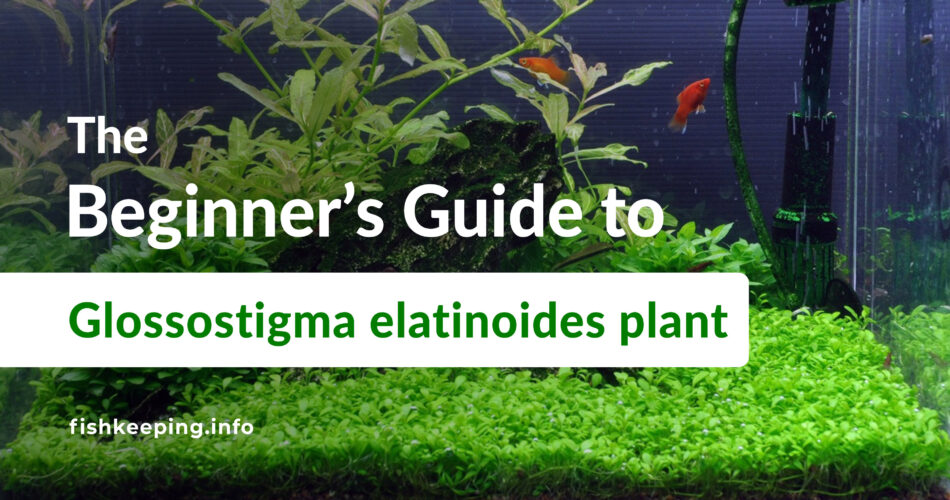
Glossostigma Elatinoides plant is great for aquascaping, as they give aesthetic look from nano tanks to large tanks (10 gallons). The ability of the plant to give a carpet-like finish on the substrate gives it its common name, Mud Mat. They make an excellent environment for peaceful community fishes. The Mud Mat plant is demanding for a beginner because of the constant care, extra fertilizer, lighting requirements, and excess CO2 levels to create the desired effect in the tank. This guide will give all the details you need to successfully grow the plant.
Glossostigma Elatinoides: Overview

Common Name
It’s commonly called Glosso or Mud mat.
Color
This trailing plant with curly branches can form a beautiful green carpet about 1 cm thick on the aquarium floor.
Habitat/Origin
The plant generally grows in lowlands and bogs and was originally found in Tasmania, South East Australia, and New Zealand.
Average Size
The rounded leaves of the plant can grow up to 5 mm in size. The internodes are about 1 cm in length, but with excellent conditions, they can grow up to 5 cm long.
Growth Rate
Favorable conditions help the plant to grow really fast. Bubbles on the water surface are proof that the photosynthesis process is taking place resulting in the proper growth of the plant. A real thick carpet can take several weeks to form.

Placement
The plant can be placed in the forefront of the aquarium tank to form a thick carpet and to improve the aesthetic look.
Maintenance
Trimming is required to not just maintain the aesthetic look but also to avoid the plant from tearing off from the substrate and floating on the water surface. If not trimmed the growth rate becomes high where the horizontal shoots shade each other and decay starts as the light does not reach the bottom. You can cut off the vertical stems. Just hold the scissors at a 45-degree angle and trim the carpet. The yellow leaves need to be removed.

Planting Methods
The plant needs to be quarantined. The clumps that are trimmed can be spread out on a tray, sprayed with aquarium water, and covered with a paper towel to lock in the moisture. Separate the plant with two leaves each, leaving a gap of 1 – 2 cm, and plant it in the substrate using tweezers so that they are not damaged during the process. The stem should be completely inside the substrate so that they do not float off. Proper care and favorable conditions will let the plant form a carpet within a month.
Ideal Setup
It is a foreground plant and needs to be planted in a place where the lighting can reach the plant. For this reason, they should not be planted under the shade of other foliage. This helps the plant to develop strong stems. It requires a soft substrate that has soft-edged grains 2 – 3 mm big to promote penetration of the roots as they are thin and long.
Care Level
The plant requires demanding care.
Supplements
The plant can grow without fertilizers, but they do not develop a uniform carpet. The use of fertilizer, especially Ferrum containing fertilizers, allows a controlled growth. The Ferrum fertilizer also helps in maintaining the green color of the plant. It is ideal to use fertilizers in the form of root tabs or dose liquid.
Lighting
The plant requires a high illumination level as it helps the plant to remain smaller and have a beautiful carpet on the tank bottom.
Water temperature
By nature, Glossostigma Elatinoides is a beach plant and hence it has weathered flooding. Also, it is capable of growing out of the water and tolerating sunlight. It can survive well in temperatures between 22 – 30 °C (72 – 86°F). The plant is also capable of blooming in summer conditions. The water can be slightly acidic (pH 5-7) water.
Propagation
The plant forms runners and lateral shoots, which later grow as mature plants.

Approximate Cost
The plant is available in a price range of 10 US dollars for a clump.
Common Diseases
Yellowing of leaves and leggy growth are results of insufficient lighting. Melting can happen in the early stages when the plant is still adapting to the aquarium conditions. There is a good chance for the leaf to rot when you don’t trim regularly.
What to look for when buying
The leaves should be green in color without any spots, curls, or rips. The plants should not have brown or yellow leaves. Make sure the plant is of the correct length. Make sure the roots are healthy as well.
Related Species
Dwarf Baby Tears Glossostigma H.C.,